It was
The first time I arrived in Chania, I was nine years old.
It was 1971. My parents had brought me back to the city where they were both born, and I walked into a world I had no words for. Extended family I had never met pulled me into embraces like I had always been there. Tables were set that seemed to have no end. Dishes arrived before the last ones were finished. Conversations overlapped in every direction. And the smells, from the kitchen, from the street, from the neighbours next door, were unlike anything I had experienced growing up abroad.
I gained four kilos in five weeks. I am not embarrassed to say it. The food was that good, and the love behind it was even better.
I came back at seventeen. And I have not missed a summer since.
Over the decades, Chania moved from a place I visited to a place I belonged to. I fell in love with it the way you fall in love with a person: slowly at first, then completely. When Splantzia was still a quiet neighbourhood of grandmothers and grandchildren, of laughter spilling out of open windows and the smell of slow cooking drifting through stone alleyways, I bought a house there. Not as an investment. As a declaration.
This is my city. And this is how we eat.
Discover the Unforgettable Food and Drink Experiences in Chania
Food in Crete is more than a way to fill your stomach. It is a way of life. Olive oil pressed from family groves, greens picked wild from the mountains or purchased from Kyrio Giorgos at the local farmers market — every Saturday morning along Minoos Street in Splantzia — or the best goat cheese yogurt and local cheeses from the Matzoraki family women. Three generations selling their delicacies at the various farmers markets scattered across Chania. Recipes passed down from grandparents to children, recipes shared among friends, and suggestions from the local farmer.
I always stop at Kyrio Giorgos for xortia, the wild greens that are quietly at the heart of Cretan cooking, and I never leave without a lesson. He will tell you to boil them simply and serve them alongside fresh fish, or to sauté them slowly with onion and white wine, or to fold them into a goat stew that needs hours on the stove and rewards every minute of waiting. And if you mention a sore knee or a stiff neck, he will disappear behind his stall and return with one of his home-brewed therapeutic oils for deep tissue massage. That is Kyrio Giorgos. That is also Chania.
Food becomes an experience. A way that friends connect. I always laugh when I receive a call from a Canadian friend during a weekend lunch. It is always the same: sorry buddy, I am out for lunch with friends, call me later. Four hours later — Greektari, are you free? No bud, still out for lunch. For lunch! Not that I blamed anyone for staying. We had xortia, antikristo lamb, tzigarasto goat, fresh salads, fried snails, and white wine that kept refilling itself. But the food was only part of it. We kept ordering more as friends and family arrived, kids dropping by to say hello, then their kids, then their parents. At one point we had four generations gathered around that table. You don’t leave a table like that. You don’t even think about it.
Cretan cuisine isn’t just Mediterranean. It is our Mediterranean. Shaped by the land, the sea, and centuries of trade, tradition, and resilience. From seaside cafés to mountain tavernas, the food here reflects not just what we grow, but who we are.
The Foundation of Cretan Cuisine
A slice of fresh bread, covered in Anthotyro — a fresh local Cretan cheese, similar to ricotta — with freshly ground ripe tomatoes drowning in olive oil. This was my favourite. After the beach, my cousin Popi would sit me down and make me one of these snacks. Hence the four kilo weight gain.
At the heart of Cretan food is a commitment to using what the land and sea offer: simple ingredients, prepared well. You will find olive oil in almost every dish, and not just any olive oil. Crete’s is some of the finest in the world, with a bold, peppery taste that speaks of sun and stone.
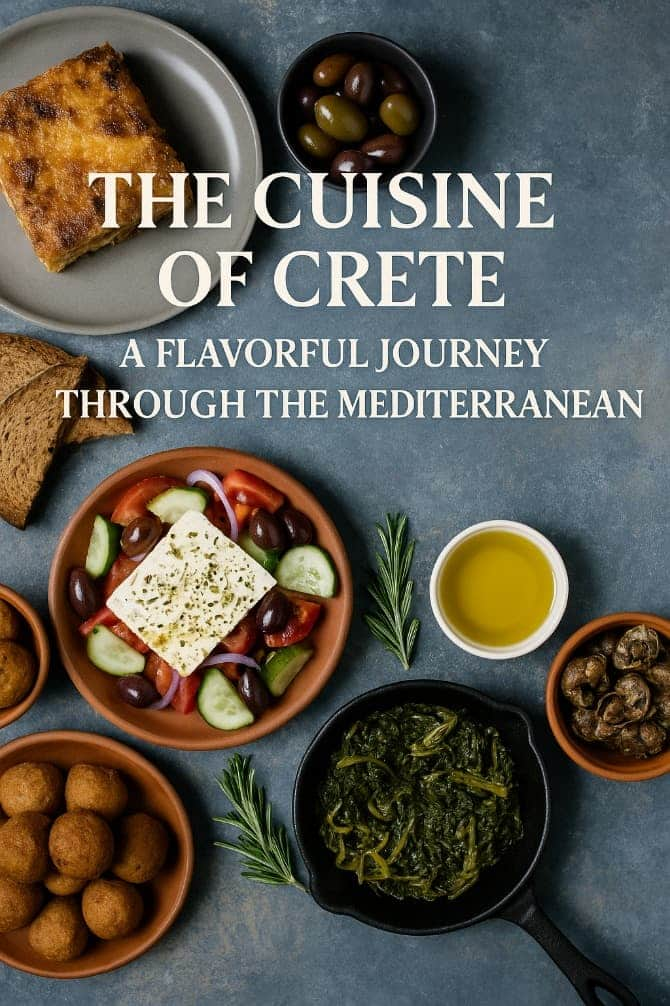
The diet leans heavily on vegetables, legumes, herbs, and seasonal greens — many of them foraged rather than farmed. Fish is abundant along the coast, while lamb and goat are common in the mountains. And nearly everything is seasoned not with heavy sauces, but with time-honoured combinations of lemon, garlic, wild oregano, and thyme.
Meals here are social. They last hours. And there is always room for just one more person at the table.
Signature Dishes of the Island
1. Cretan Salad (Choriatiki)
More than just a Greek salad with a twist, the Cretan version starts with a thick slice of rustic barley bread at the base, soaking up the juices from tomatoes, cucumbers, onions, olives, and local cheese — usually mizithra. It is humble, hearty, and impossibly fresh.
Mizithra is the Cretan alternative to feta. The trick is to mix it into the salad so it blends with the oils, then take a piece of crusty bread and reach in for a huge papara — a deep dunk into the bowl, scooping up the creamy mizithra as it dissolves into the olive oil and oregano. One of my favourite places for this is Bourbos Café. Preferred by locals, occasionally discovered by lucky tourists. The best meatballs in Chania, at an unbelievable price point. You will go and you will not feel like leaving.
2. Moussaka (Cretan-Style)
Layers of roasted eggplant, lamb or beef, béchamel, and the secret weapon: a whisper of cinnamon, allspice, and clove. Comfort food with a hint of the exotic. For a wonderful vegetarian version, try To Stachi — traditional vegetarian cuisine including boureki and stuffed zucchini flowers with rice and aromatic herbs.
3. Kalitsounia
I can eat these all day. Little hand pies — pure Cretan magic. Some are savoury with wild greens or soft cheeses, others sweet with honey and cinnamon, called Lychnarakia. You will find them at bakeries, markets, and festivals, and they disappear fast. My favourite are served at the small café at the side portico of Chania City Hall. Even my local friends vote these among the best.
4. Lamb or Goat with Stamnagathi
Tender lamb stewed slowly with stamnagathi, a bitter wild green foraged in the hills. Earthy, slightly tangy, beautifully rustic. Most of the time finished with egg and lemon sauce — traditional Greek avgolemono.
5. Chochlioi Boubouristi (Fried Snails)
My favourite. I always tell guests: don’t knock it till you try it. These tiny snails are flash-fried in olive oil with vinegar, rosemary, and oregano. Crunchy outside, tender inside. I prefer them over escargot any day — Cretan snails are smaller, less chewy, and packed with flavour.
6. Tzigarasto
The soul of the mountains. Lamb or goat slow-cooked with tomatoes, garlic, olive oil, and a mountain of herbs. I prefer the meat cut into bite-size morsels that brown easily in the pot, until it falls off the bone. Finish with a piece of crusty bread and a papara to wipe the plate clean. One of the great pleasures of this island.
7. Antikristo
An old, traditional method of roasting meat opposite the fire — hence the name. Lamb or goat seasoned with salt and herbs, slow-roasted for hours over open flames. Crispy outside, melting inside, and usually reserved for big gatherings or festivals. When you smell this in the air, you know something special is happening. The tavernas surrounding Lake Kourna are known for their antikristo — making the lake an enjoyable excursion that pairs well with a swim.
8. Cretan Cheese
Cheese is not a side note in Crete. It is a cornerstone. Mizithra, Graviera, Anthotyro — every village has its favourite. Some creamy and mild, others aged and nutty. Try them with a drizzle of honey or paired with a glass of wine and local olives. Start your morning with a piece of Graviera and honey on a Cretan rusk and you will understand everything.
9. Raki and Honey
Meals end with a treat — almost always. A shot of tsikoudia, what we call raki here, often homemade and served with fruit, dessert, or sweet cheese pies. And if you are lucky, a spoonful of thick herbal Cretan honey on yogurt or cheese. It is one of the best parts of the meal.
My Favourite Places to Eat in Chania
Everyone asks where to eat. And while the harbour is beautiful, it is rarely where we locals go. Here are my personal favourites.
Kouzina EPE
What I love most about Kouzina EPE is something you will not find in most restaurants anywhere in the world. You walk in, look into the pots, and choose. A scoop of this, a spoonful of that, your own plate built from whatever came out of the kitchen that morning. My personal anchor is the gigantes — butter beans slow-cooked in the oven with fresh tomato sauce and fresh herbs until they are soft, rich, and completely impossible to stop eating. But honestly, whatever is in those pots that day is what you should be eating. Trust the kitchen.
Tamam
Tamam sits inside a beautifully restored building that is centuries old, its stone walls and vaulted ceilings carrying the kind of atmosphere that no designer can manufacture and no new restaurant can replicate. It earns its place on this list not just for the food — which is creative, thoughtful, and rooted in Cretan tradition — but for what it has meant to me personally. My daughter lives in Melbourne. When she comes home to Chania, Tamam is where we go. Usually with her friends in tow, a full table, a long evening, and that particular kind of happiness that only arrives when someone you love is sitting across from you in a place that feels like it has always been there. Some places earn their reputation honestly. Tamam is one of them.
To Stenaki
Located close to the Trimartiri Church, the central cathedral. My nephew and his wife recently took me there and I was impressed. From the outside it does not promise much. The food was excellent and the price point very decent.
To Maridaki
Literally down the street from my house, which means I have a complicated relationship with it. In summer I largely avoid it. The lines tell you everything you need to know about how good it is, and also why a local with any patience learns to time their visits carefully. But winter is when To Maridaki truly belongs to us. The tourists are gone, the tables open up, and the regulars reappear like the restaurant exhales. The fish soup is extraordinary. I will not oversell it beyond that because some things need to be experienced rather than described. During peak summer months I call ahead and take it away. I have done this more times than I can count.
Pallas
There is a rule I generally stand by: the harbour restaurants in Chania are for tourists, and locals know better. Pallas is my exception, and I make it without apology. The location is simply irreplaceable. Sitting on the harbour with the morning sun coming in, a coffee in hand, a fresh croissant on the plate, and the sea breeze doing whatever it wants. That experience does not get old. For a special evening, the rooftop is the move. Book days in advance. The sunset from up there over the Venetian harbour is the kind of view that makes you forget what you were worried about.
Psarotaverna O Stelios
Quaint, fresh fish, very well priced, and open all year. I send all my friends there and never fail to receive favourable remarks. My Italian friends enjoy it so much they generally return a second and third time. Why do I emphasise Italian? Because Italians believe, in the most part, that they have the best cuisine. Two thumbs up from an Italian is a strong endorsement.
Stay in the Heart of Flavour and History
Everything I have described in this post — the farmers markets, the mountain stews, the four-hour lunches, the harbour sunsets, the kalitsounia from the City Hall café — is within walking distance of where you will sleep.
My studios sit in the heart of Splantzia, surrounded by some of the neighbourhood’s most beloved spots. The Well of the Turk is practically a neighbour. Boulevard of Broken Dreams is steps away for a late evening drink. And yet despite being at the centre of everything, the studios are quiet. Genuinely quiet. The kind of sleep you forget is possible until you wake up in a 17th-century Ottoman stone house and remember where you are.
The old port is less than 100 metres away. The Old Town is your front garden.
I have spent more than fifty years falling in love with this city — first as a boy overwhelmed by family and food, then as a young man who could not stay away, and eventually as someone who bought a house in Splantzia when it was still just grandmothers and grandchildren and the smell of something wonderful cooking behind every door. Opening these studios is my way of sharing what Chania gave me.
Come and stay. I will be here with recommendations, local knowledge, and whatever you need to make this city yours. Oscar, the family dog, will be here too.