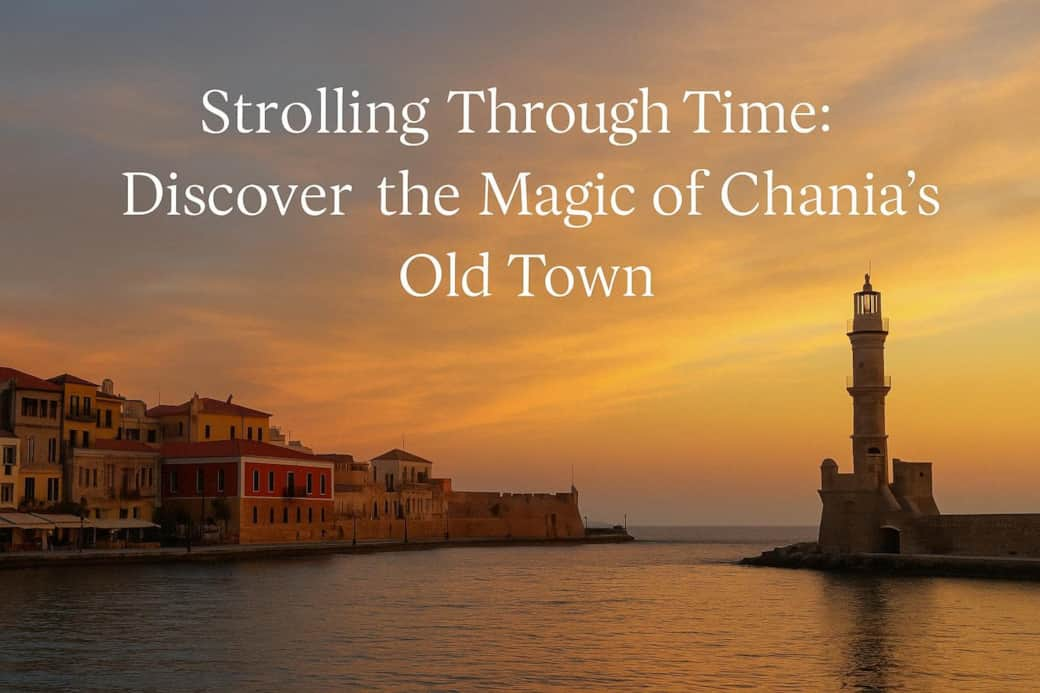
Strolling Through Time: Discovering Chania’s Old Town
The first time my father brought me to Chania, I was nine years old. I did not understand yet what I was seeing. I just knew that the streets were old in a way that felt alive, that the harbour smelled of salt and wood and something frying somewhere, and that the people we passed seemed to know each other in a way that people in Canada did not. I came back at seventeen. And I have not missed a summer since.
Over fifty years of walking this city, you learn things that no guidebook carries. You learn which corner of the harbour catches the last light. You learn that the places worth finding require a short walk inland and a willingness to follow your nose. And you learn that Chania is a city built in layers — Venetian, Ottoman, Greek — and that the layers do not cancel each other out. They accumulate.
The Venetian Harbour and Firkas Fortress
I have walked the Venetian Harbour more times than I can count, in every season and at every hour, and it has never once looked the same twice. Early morning before the tourists arrive, the water is still and the light comes in low across the lighthouse. In summer evenings the whole harbour front comes alive in a way that is impossible to resist even when you have seen it a hundred times.
Winter is when it belongs to the city again. From around the end of January through to March, many of the storefronts along the old port close — not because business is bad, but because this is when the owners and their staff rest. The waves push up to the doors. The streets empty. And those of us who live here head to the mountains, in search of home-cooked Cretan food in village tavernas that have no reason to perform for anyone. That is a different Chania entirely, and I am glad I get to live in both of them.
The Egyptian Lighthouse at the end of the breakwater is where I always end up eventually. Standing there with the harbour behind you and the open sea ahead, you understand something about why this city has always been worth fighting over.
Firkas Fortress at the western end was built by the Venetians in the 1600s. It became barracks and prison under Ottoman rule. In 1913 the Greek flag was raised here for the first time after centuries of occupation. The courtyard on summer evenings becomes a cultural venue under the open sky — one of those Chania experiences that feels entirely accidental until you are in the middle of it.
The Grand Arsenal
Walking east along the harbour from Firkas, you pass the Grand Arsenal — the great stone structure the Venetians built in the late 1500s to house and repair their fleet. The soaring arches and the scale of the thing tell you immediately how seriously Venice took this harbour. It has served as shipyard, hospital, and warehouse over the centuries. Today it is a cultural centre hosting exhibitions and events. I love how the exposed stone connects every era it has passed through without apology.
The Maritime Museum and Kyrie Theodoros
At the eastern end of the inner harbour, tucked into one of the original neorios — the vaulted stone boathouses the Venetians built to shelter their ships — is the Maritime Museum. The centrepiece is a full-scale replica of a Minoan trireme, built to mark the 2004 Athens Olympics and sailed by a crew from Chania all the way to Athens under oar. It is an extraordinary thing to stand beside.
What the museum does not tell you is that the man who helped build it worked in a workshop whose wall was the same wall as the museum’s. Three metres. That was the distance between his workbench and the vessel now on display inside.
His name was Kyrie Theodoros. He was one of the last working boat builders in the old neorios, and in his later years, in the mid to late 1990s, he would often be found sitting outside his workshop in the afternoon sun. I would stroll over and he would talk — about boats, about the harbour, about the way things had been. Sometimes a fisherman friend had brought him a good catch and he would insist you stay and eat. Fresh fish, simply prepared, eaten outside a stone workshop that had been building boats since before either of us was born.
There is still a boat he built for the Scouting organisation moored in front of the sailing club nearby. I own the rudder of a wooden kaiki he once worked on — the steering blade from the stern, shaped timber worn smooth by years in the water. It is in storage. It shows its age. I am glad I have it.
Kyrie Theodoros passed away around the turn of the century. There are photographs of him working on the trireme. I am glad those exist too.
What I feel when I think about him is not only personal loss. It is something larger. We did not just lose a craftsman when his generation passed. We lost the trades, the rhythms, the particular knowledge of a life lived close to the sea. The grandmothers who commanded the kitchen are mostly gone. The farmers who knew every wild green by name are fewer. The Cretan spirit — the individuality, the customs, the way of life — is quieter than it was. I am glad I was here during those years. I learned things in this city that I could not have learned anywhere else.
Etz Hayyim Synagogue
Tucked into a quiet corner of the Old Town, easy to miss if you are not looking, is Etz Hayyim — the last surviving synagogue in Crete. The building has been a Catholic church, a Jewish house of worship, and a ruin. It has been restored. There is a calm here that you feel before you understand it.
Just around the corner, Sinagogi Bar occupies an open-air courtyard with a tree growing through its centre. Some of the best cocktails in town, and one of the more quietly remarkable places in the city to sit with a drink in the evening.
Splantzia Square
Splantzia Square is where I come when I need to remember why I live here. The Church of St. Nicholas at its centre bears both a bell tower and a minaret — the bell tower added after the church was reclaimed from use as a mosque during Ottoman rule. Both are still there. That is Chania in one building: nothing erased, everything accumulated.
Locals gather here at all hours. In summer it fills with visitors who have found their way off the harbour and into the streets where people actually live. In the off-season it belongs to the neighbourhood again — the same faces, the same rhythms, the coffee that arrives without being asked for because you have been coming long enough that asking is no longer necessary.
Stay in the Middle of It
The building where I live and where our studios are is on Parados Sorvolou, steps from Splantzia Square. It is a 17th-century Ottoman stone house — four floors, four independent spaces. The ground floor is Studio Petra. The second floor is Studio Lithos. My nephew lives on the first floor. I am on the top.
I have spent more than fifty years falling in love with this city. Opening these studios is my way of sharing what Chania gave me. If you stay with us, ask. We know where the light falls best in the evening and which alleys are worth getting lost in.